
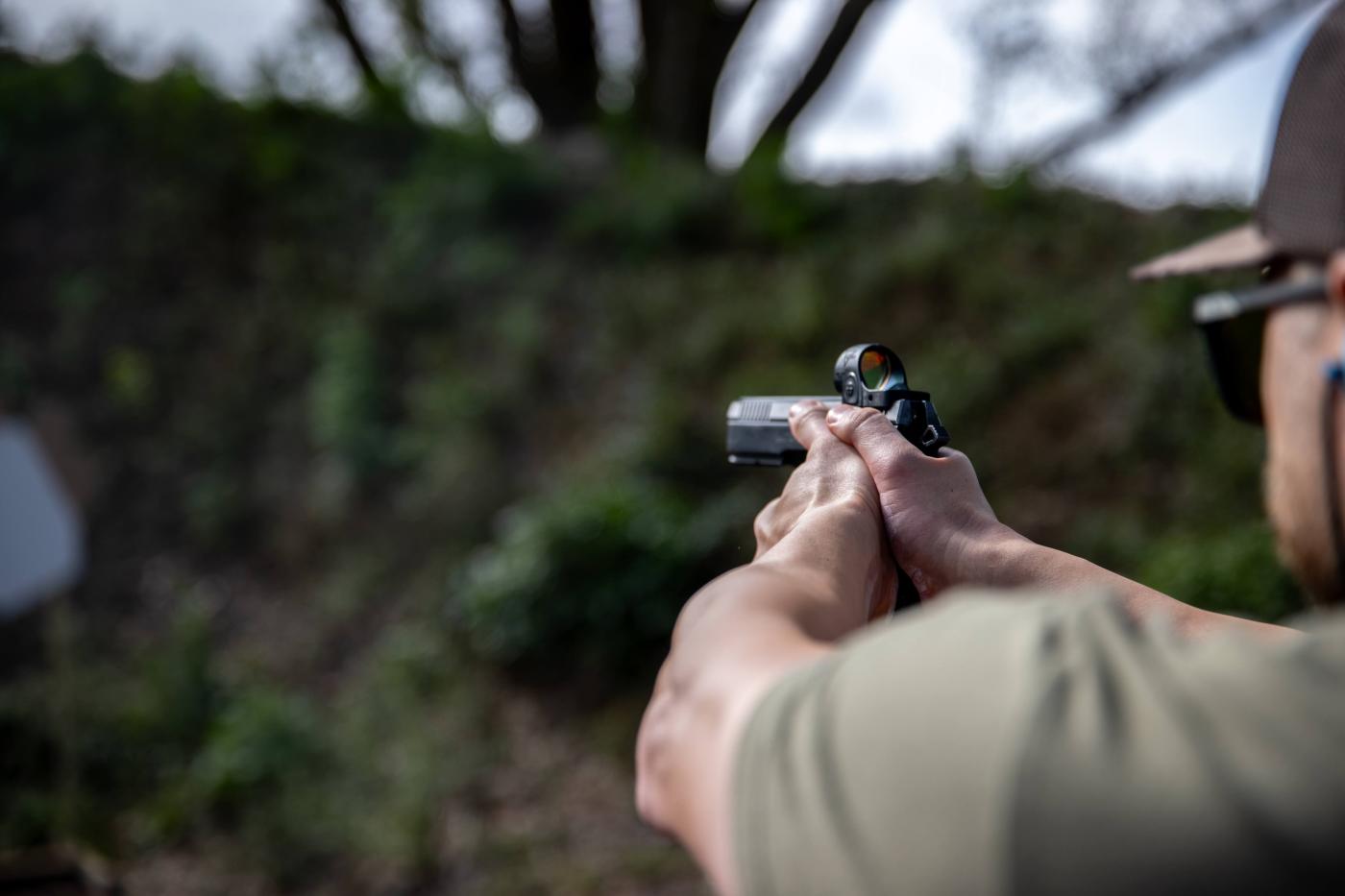
Many shooters grapple with finding their red dot. A recent trend suggests that those encountering difficulty should resort to their iron sights, as if invoking a magical return of the dot to the window. However, this advice, indicative of a training problem, filters down to those less informed.
Despite the progressive nature of training and ideas from many manufacturers, a subtle assumption persists. When companies secure significant military contracts and hire former military personnel involved in awarding those contracts, antiquated training concepts tend to permeate the manufacturer’s training methods.
In a revealing, now-deleted video from a reputable company, two prevalent issues were highlighted: difficulty locating the red dot upon presentation and losing it after recoil. The instructor’s solution for both predicaments was remarkably straightforward—locate the iron sights, and the red dot seamlessly reappears. The second issue was attributed to a follow-through problem. But what does follow-through have to do with finding your red dot? Losing the dot after recoil is either a grip issue or an issue with aggressively returning the gun out of recoil. The shooter should grip the gun in a manner that allows the sight to return predictably to the spot it left.
Follow-Through
Let’s delve into the concept of follow-through. It involves pulling the trigger and allowing the bullet to exit the barrel without disrupting the gun’s alignment. Any input causing the gun to move out of alignment before the bullet departs is deemed a lack of follow-through (i.e., a pre-ignition flinch or gripping the whole firing hand as the trigger is pulled). Thus, the only follow-through needed is the information you receive visually from the dot or the sights right before recoil occurs, otherwise known as “shot calling.”
Fundamentals that facilitate follow-through, such as isolating the trigger finger from the grip and maintaining a solid grip with the support hand, should not be confused with follow-through itself. Follow-through is most often confused with the fundamentals that occur after recoil, like resetting and prepping the trigger or getting another sight picture on the target. These concepts find more of a home in the law enforcement training community where the infamous training flaw of pinning the trigger exists.
Natural Point of Aim
Another debated topic is the Natural Point of Aim, frequently discussed in law enforcement and military shooting communities. However, explanations often tend to be vague or dismissed as irrelevant. The notion revolves around aligning one’s body with the target to maximize skeletal structure use while minimizing unnecessary tension. Although theoretically sound, it lacks practicality. Here’s a revelation—anything learned through repetition isn’t truly natural. Thus, the Natural Point of Aim has never existed. Remarkably, shooters have clinched national titles with more shoulder tension than I have applied in a year of my personal shooting. This goes to show that any mediocre method done with enough repetition can yield results. This does not mean we should start new shooters off with a less than optimal technique. Many aspects of practical shooting are achieved without an optimal stance and alignment with the target. However, the key here is the “index.”
Index
In the shooting realm, index can mean several things. In the context of aiming, it refers to the ability to focus on a specific spot on a target and present the gun with the sights in alignment on that spot. If shooters find themselves adjusting the sights after presenting the gun, they are deceiving themselves. The absence of an index is precisely why shooters struggle to locate the red dot.
Vision Drives Your Shooting
The significance of a reliable index extends to all aspects of shooting, particularly during transitions between targets. When a shooter’s eyes get to a specific spot on a target, their gun shows up in alignment on that spot.
A Training Problem
The transition from iron sights to red dots poses a significant challenge for many law enforcement agencies. Officers often engage in range qualification two or four times a year without personal practice to cultivate a proper index. During qualifications, there is ample time to fix the sights after aiming in, rendering a robust index unnecessary. The transition to a red dot becomes more problematic. When the shooter aims in, and the dot is entirely absent from the window, they resort to contorting their wrists in desperation to locate the red dot. This takes time and is counter to the idea of how simplistic and intuitive it is to shoot with a red dot. If there is an unwillingness to train on a personal level, there is no reason to transition to a red dot.
The straightforward solution to this conundrum is clear—shooters should have developed a solid index with their iron sights before venturing into the realm of red dots. In practical scenarios like law enforcement or military applications, if the dot isn’t visible, an immediate transition to iron sights is imperative. Whether the dot is malfunctioning or the battery is dead, accurate rounds on target take precedence. Notably, the instruction is to transition to irons, not transition to irons to find the red dot. With a solid index, a good shooter would swiftly discern that their red dot is malfunctioning and immediately transition to backup irons.
Creating a Reliable Index
Here is one way to create a reliable index:
- Begin with your gun in a position close to where both your hands meet during the draw—a ready position.
- Keep the gun level with the ground, avoiding any upward or downward angles.
- Any angled muzzle “high ready” or “compressed ready” is a temporary position where you do not wish to point your gun at certain people. This exercise is designed to develop an index and does not attempt to add any “tactical” positions.
- Set your grip in this position.
- Select a specific spot on the target (a small piece of black tape works well).
- Aim in by presenting the gun directly to the target. If the sight does not land on the chosen spot, make the necessary adjustment. Keeping everything set the way it is, return to a high ready position by bending only your elbows, then repeat.
- Begin slowly, ensuring honesty in your self-assessment.
- Increase speed during the presentation but taper off speed near the end (the last few inches of your presentation) to guarantee the dot lands on the spot.
This exercise can be done with iron sights or a red dot at any practical distance. Perform this exercise with escalating speed, and if you wish, add a timer with a par-time (two beeps that you manually decrease in time). If you encounter failure, revert to the speed at which you were successful and repeat. For law enforcement officers, this could be a brief five-minute drill prior to their shift. Once proficiency is achieved, progression to working from the holster becomes the next step. When drawing from the holster, it’s crucial to maintain the same grip as in the previous exercise. Deviating from this grip may result in misalignment of your sight(s). This is just the beginning of dry-fire practice.
A dry-fire resource:
Practical Shooting Training
-Wes
 U Suck At Shooting
Leave a comment